Now Reading: Best Generative AI Software for Businesses 2025
-
01
Best Generative AI Software for Businesses 2025

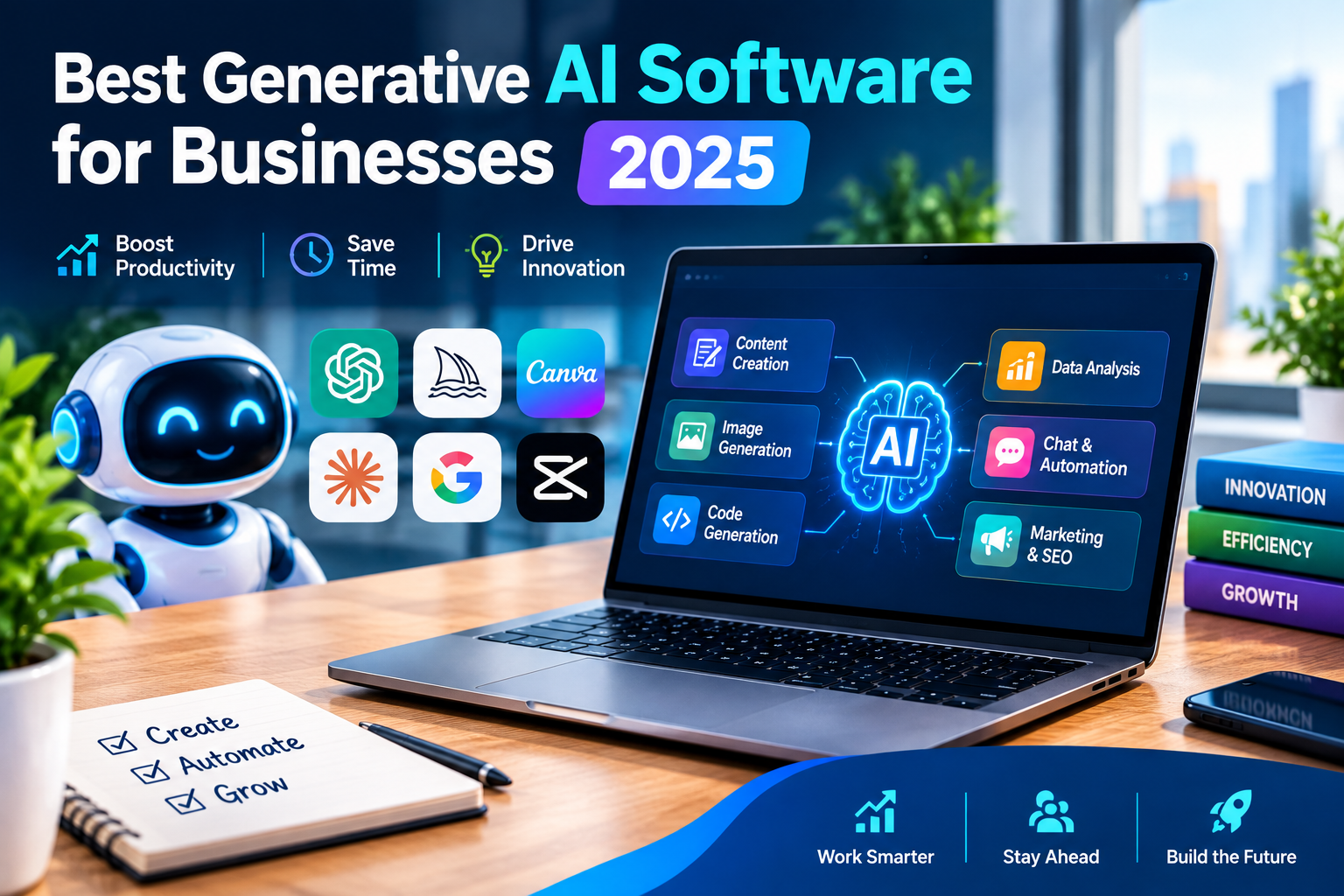
Generative artificial intelligence has quickly become one of the most useful technologies for modern businesses. In 2025, companies of all sizes are using generative AI to create content, analyze information, automate repetitive work, support customers, improve productivity, and develop new ideas. Choosing the best generative AI software for businesses 2025 depends on the company’s goals, workforce, budget, security requirements, and existing technology.
Businesses are no longer using AI only for experimentation. Generative AI has become part of everyday workflows, helping employees complete tasks faster while allowing organizations to focus more attention on strategy and customer relationships. NewTechEveryDay explores how businesses can understand this growing technology and select solutions that provide genuine value.
What Is Generative AI Software for Businesses?
Generative AI software uses artificial intelligence models to produce new content based on instructions or existing information. Depending on the platform, it can generate written content, images, presentations, software code, summaries, reports, ideas, and other business materials.
Unlike traditional software that follows fixed instructions, generative AI can respond dynamically to natural-language prompts. This makes it useful for employees who may not have technical expertise. A marketing professional can ask an AI system to develop campaign ideas, while a manager can use it to summarize a lengthy report or prepare an initial business document.
The best generative AI software for businesses 2025 should do more than simply generate impressive outputs. It should provide practical business value, maintain appropriate security, integrate with existing workflows, and help employees accomplish meaningful tasks.
Why Businesses Are Adopting Generative AI
One of the biggest reasons businesses are investing in generative AI is productivity. Employees often spend significant amounts of time performing repetitive activities such as drafting emails, organizing information, creating summaries, preparing documents, and researching topics.
Generative AI can assist with many of these responsibilities. It can create a first draft, organize unstructured information, suggest improvements, or provide ideas that employees can review and refine.
AI can also help businesses provide faster customer service. AI-powered assistants can answer common questions, summarize customer interactions, and help support teams find relevant information. When used appropriately, these capabilities can reduce workloads while improving response times.
Another advantage is scalability. A growing company can use AI tools to support increasing volumes of content, customer questions, documentation, and internal communication without requiring every task to be handled manually.
Key Features to Look for in Business AI Software
When evaluating the best generative AI software for businesses 2025, companies should consider several important characteristics. The quality of generated content is important, but it is only one part of the decision.
Security should be a major consideration, particularly when employees may work with confidential business information. Organizations should understand how a platform handles data, what administrative controls it provides, and what privacy protections are available.
Integration is another important factor. AI software becomes more useful when it fits naturally into existing business applications and workflows. Employees should not have to constantly move information between unrelated systems to use AI.
Ease of use also matters. A powerful platform may have limited value if employees find it difficult to understand. Intuitive interfaces, useful prompting capabilities, collaboration features, and administrative controls can make adoption easier.
Businesses should also consider scalability, reliability, pricing, customization, and the ability to manage users and permissions.
Generative AI for Content Creation
Content creation is one of the most common applications of generative AI. Businesses can use AI to brainstorm blog topics, create initial drafts, summarize research, prepare social media ideas, develop advertising concepts, and improve existing content.
For marketing teams, this can significantly reduce the time required to move from an idea to a first draft. However, businesses should maintain human review to ensure that content is accurate, original, appropriate for the target audience, and consistent with the company’s brand voice.
NewTechEveryDay recognizes that AI works best as a productivity partner rather than a complete replacement for human creativity. Human experience remains important for understanding customers, making strategic decisions, and adding authentic perspectives.
Generative AI for Customer Support
Customer service is another area where generative AI can deliver significant benefits. AI assistants can help customers find answers to frequently asked questions and guide them toward relevant information.
For internal support teams, AI can summarize conversations, prepare suggested responses, organize customer information, and help agents locate relevant documentation. This allows customer service representatives to spend more time handling complex situations that require empathy and judgment.
Businesses should carefully monitor AI-generated responses in customer-facing environments. Incorrect information can damage customer trust, so human escalation and appropriate quality controls remain important.
Generative AI for Business Research
Research can be time-consuming, particularly when employees need to review large amounts of information. Generative AI can help summarize documents, identify themes, compare information, and organize research questions.
For example, a business team preparing for a meeting may use AI to transform lengthy documents into concise summaries. An analyst may use it to organize ideas before conducting deeper research.
AI-generated research should still be verified against reliable sources. Generative AI can produce incorrect or misleading information, making human verification an important part of responsible business use.
Generative AI for Software Development
Software development teams are also benefiting from generative AI. AI coding assistants can help developers write code, explain unfamiliar code, identify potential problems, generate tests, and accelerate routine programming tasks.
These tools can be particularly useful for repetitive development work. Developers can spend less time on boilerplate code and more time thinking about architecture, security, performance, and product requirements.
Businesses should still require developers to review AI-generated code carefully. AI assistance can accelerate development, but it does not eliminate the need for experienced engineering judgment.
Generative AI for Data and Document Analysis
Modern organizations produce enormous quantities of documents and information. Generative AI can help employees make sense of this material by summarizing reports, extracting key points, comparing documents, and transforming complex information into easier-to-understand formats.
This can be useful for departments such as finance, human resources, operations, sales, and management. Instead of manually reviewing every piece of information, employees can use AI to create an initial overview and then investigate the most important areas.
The quality of this process depends heavily on the accuracy of the underlying information and the safeguards surrounding sensitive data.
Choosing the Right AI Solution for Your Business
There is no single AI platform that is automatically the best choice for every company. A small business may prioritize affordability and simplicity, while a large organization may require advanced administration, security controls, integrations, and enterprise support.
Before selecting software, businesses should identify the problems they want AI to solve. Starting with specific use cases is often more effective than adopting AI simply because it is popular.
Companies should also conduct small pilot projects before expanding AI across the organization. A pilot allows teams to measure productivity improvements, identify risks, gather employee feedback, and determine whether the technology actually delivers value.
Responsible Use of Generative AI
Responsible AI adoption is essential for long-term success. Employees should understand that AI-generated information can contain errors. Businesses should establish clear guidelines for confidential information, human review, intellectual property, and customer-facing communications.
Training is equally important. Employees who understand how to write effective prompts, verify AI outputs, and recognize limitations are more likely to use AI effectively.
Organizations should treat AI governance as an ongoing process. As technology develops, businesses may need to update policies, security practices, and employee training.
The Future of Generative AI in Business
The role of generative AI is expected to continue expanding as businesses discover new applications. AI systems are becoming increasingly capable of working across text, images, data, software, and other types of information.
In the future, businesses may increasingly use AI agents and automated workflows capable of completing multiple connected tasks. Instead of simply answering a question, an AI system may help coordinate research, prepare documents, analyze information, and support business processes.
However, successful adoption will continue to depend on more than technological capability. Businesses will need strong leadership, clear objectives, reliable data, employee training, and responsible governance.
Final Thoughts on the Best Generative AI Software for Businesses 2025
The best generative AI software for businesses 2025 is ultimately the solution that addresses real business needs while providing appropriate security, usability, scalability, and value. Generative AI can support marketing, customer service, research, software development, document analysis, and many other areas of an organization.
Businesses should avoid choosing technology based solely on popularity. Instead, they should identify specific problems, evaluate suitable AI capabilities, test solutions through practical use cases, and measure the results.
NewTechEveryDay believes that generative AI represents an important opportunity for businesses to work more efficiently and creatively. When implemented thoughtfully, AI can become a valuable business tool that supports employees, improves workflows, and creates opportunities for sustainable growth.