

Now Reading: Product Recommendations Engine: The Science Behind Predicting Customer Intent
-
01
Product Recommendations Engine: The Science Behind Predicting Customer Intent

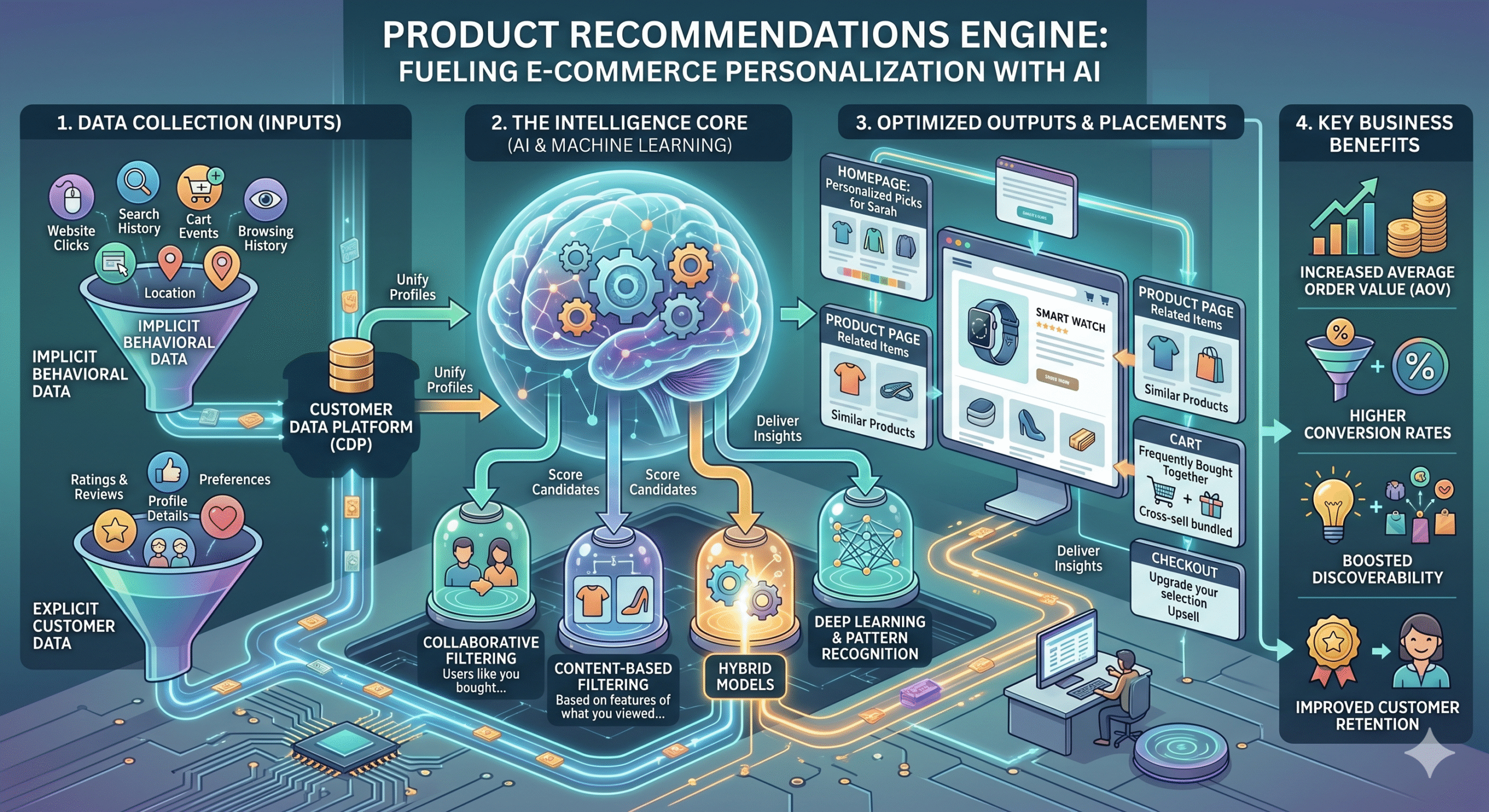
In the world of ecommerce, understanding customer intent is the difference between a casual browser and a paying customer. With thousands of products competing for attention, users often rely on guidance to make decisions. This is where a product recommendations engine plays a critical role.
Rather than leaving customers to search manually, recommendation engines anticipate what users are likely to want next. By analyzing behavior, preferences, and patterns, they transform raw data into meaningful suggestions that drive engagement and conversions.
The real power of a product recommendations engine lies in its ability to predict intent before the customer explicitly expresses it.
What is a Product Recommendations Engine?
A product recommendations engine is a system that uses data, algorithms, and machine learning to suggest relevant products to users. These suggestions are tailored to each individual based on their interactions with the platform.
The engine considers multiple signals, including:
- Browsing history
- Purchase behavior
- Search queries
- Product attributes
- User preferences
Instead of offering generic suggestions, it delivers personalized recommendations that align with the user’s interests and intent.
Understanding Customer Intent
Customer intent refers to what a user is trying to achieve during their interaction with a platform. It can be broadly categorized into:
- Exploratory intent, where users are browsing without a specific goal
- Transactional intent, where users are ready to make a purchase
- Informational intent, where users are researching products
A product recommendations engine analyzes signals to identify this intent and adjust recommendations accordingly.
For example, a user who repeatedly views a specific category may be closer to making a purchase than someone casually browsing multiple categories.
The Science Behind Recommendation Engines
The effectiveness of a product recommendations engine is driven by its underlying algorithms and data processing capabilities.
Collaborative Filtering
This approach analyzes the behavior of similar users to make recommendations. If users with similar preferences purchased certain products, those products are recommended to others in the same group.
Content-Based Filtering
Recommendations are based on product attributes and user preferences. If a user frequently interacts with a specific category or brand, similar products are suggested.
Hybrid Models
Most modern systems use a combination of collaborative and content-based filtering to improve accuracy and diversity.
Machine Learning Models
Advanced engines use machine learning to continuously learn from user interactions. This allows them to adapt to changing behavior and improve recommendations over time.
Real-Time Personalization and Intent Prediction
One of the key advancements in recommendation engines is the ability to process data in real time. This enables the system to respond instantly to user actions.
For example:
- Clicking on a product can influence the next set of recommendations
- Adding items to the cart can trigger complementary suggestions
- Searching for a category can refine recommendations across the platform
This real-time feedback loop allows the engine to refine its understanding of user intent continuously.
Key Use Cases
Homepage Personalization
The homepage is often the first interaction point. Personalized recommendations help capture user interest immediately and guide them toward relevant products.
Product Detail Pages
Showing related or complementary products encourages users to explore more options and increases the likelihood of additional purchases.
Cart and Checkout Pages
Recommendations at this stage focus on cross-selling and upselling, helping increase average order value.
Email Campaigns
Personalized recommendations in emails drive repeat visits and engagement.
Post-Purchase Engagement
After a purchase, recommendations can encourage repeat buying by suggesting relevant products.
Benefits of Predicting Customer Intent
Increased Conversions
Relevant recommendations reduce friction and make it easier for users to make purchasing decisions.
Higher Average Order Value
Upsell and cross-sell strategies are more effective when recommendations align with user intent.
Improved Customer Experience
Personalized suggestions make the shopping experience more intuitive and enjoyable.
Better Customer Retention
Consistent relevance builds trust and encourages repeat visits.
Efficient Product Discovery
Users can find what they are looking for faster, reducing frustration.
Challenges in Building Effective Recommendation Engines
Cold Start Problem
New users or products may lack sufficient data, making it difficult to generate accurate recommendations.
Data Quality Issues
Inaccurate or incomplete data can reduce the effectiveness of recommendations.
Over-Personalization
Focusing too much on past behavior can limit product discovery and reduce variety.
Scalability
Handling large volumes of data and users requires robust infrastructure.
Addressing these challenges requires a combination of technology, strategy, and continuous optimization.
Best Practices for Implementation
Use High-Quality Data
Ensure that data is accurate and comprehensive. The quality of recommendations depends on the quality of data.
Leverage Real-Time Signals
Incorporate real-time behavior to keep recommendations relevant.
Balance Personalization and Discovery
Introduce new and diverse products alongside personalized suggestions.
Optimize Placement
Strategically place recommendations across the customer journey to maximize impact.
Continuously Test and Improve
Regular testing helps refine algorithms and improve performance.
The Role of AI in Predicting Intent
Artificial intelligence enhances recommendation engines by enabling deeper analysis and more accurate predictions.
AI can:
- Identify complex patterns in user behavior
- Predict future actions
- Adapt to changing preferences
- Automate decision-making
This allows businesses to move from reactive recommendations to proactive intent prediction.
The Future of Product Recommendations Engines
As technology evolves, recommendation engines are becoming more advanced and integrated.
Future developments include:
- Visual and image-based recommendations
- Voice-driven product discovery
- Hyper-personalization using real-time data
- Integration with search and customer data platforms
These advancements will further improve the ability to predict customer intent and deliver relevant experiences.
Conclusion
A product recommendations engine is more than just a tool for suggesting products. It is a system designed to understand and predict customer intent.
By leveraging data, machine learning, and real-time insights, businesses can deliver personalized experiences that drive engagement and conversions.
In a competitive ecommerce landscape, the ability to anticipate customer needs and guide them toward the right products is a key differentiator. Businesses that invest in advanced recommendation engines will be better positioned to succeed and grow.