Now Reading: Healthcare Cleaning: Beyond the Mop Bucket
-
01
Healthcare Cleaning: Beyond the Mop Bucket

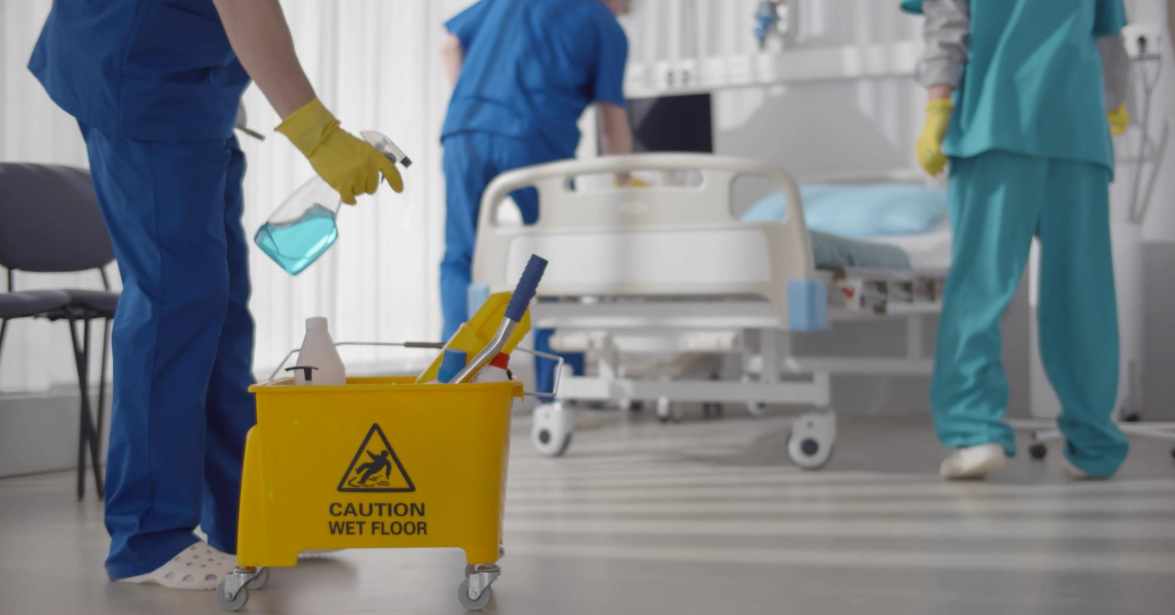
People tend to picture cleaning as a mop, a bucket, and some elbow grease. In a healthcare setting, that picture falls apart fast. Cleaning a clinic or hospital is a different kind of work, governed by a tight set of rules and aimed at a goal that ordinary cleaning never has to think about. The job is to stop illness from moving from one person to the next, and that takes far more than a mop bucket and good intentions.
This article looks at what sets healthcare cleaning apart, the standards behind it, and why so much of the work happens at a level most people never see.
A Different Kind of Clean
In most buildings, cleaning is about looks and comfort. In a healthcare setting, it is about infection control. People walk into clinics already sick or hurt, and the last thing they need is to pick up something new while they wait for care. A single missed surface can carry bacteria or a virus to the next person who touches it.
That changes the whole approach. The job is not done when a room looks clean. It is done when the room is free of the things that make people sick, and that takes a method, not just effort. A surface can shine and still be covered in germs, which is exactly the gap healthcare cleaning is built to close.
The Standards Behind the Work
Healthcare facilities follow guidance from health agencies that spell out how these spaces have to be cleaned and disinfected. These rules cover which products work against which germs, how long a disinfectant has to sit, and how often each area needs attention.
Cleaning Versus Disinfecting
People use these two words like they mean the same thing, but they do not. Cleaning removes dirt and grime. Disinfecting kills the germs left behind. Both matter, and the order matters too. A surface has to be cleaned first, because disinfectant cannot work through a layer of dirt. Skipping the first step makes the second one fail, which is one of the most common ways cleaning goes wrong in places that cannot afford it.
Dwell Time
Disinfectants need time to work. The label lists a dwell time, which is how long the product has to stay wet on a surface to kill what it is meant to kill. Wiping it off too soon leaves germs alive. This is the kind of detail that separates real disinfection from the appearance of it, and it is exactly what healthcare facility disinfection standards are built around.
The Work You Never See
Much of what makes healthcare cleaning effective happens below the surface, in the methods and systems that keep germs from spreading on the cleaning tools themselves.
Stopping Cross-Contamination
One of the biggest risks is moving germs from one area to another on a cloth or mop. A rag used in a restroom that then wipes an exam table carries everything it picked up. To stop this, healthcare cleaning often uses a color-coded system. Cloths and mops of one color go to restrooms, another to patient areas, and so on. The colors keep the tools separate so nothing crosses from a dirty zone into a clean one.
High-Touch Surfaces
Some spots get touched far more than others, and those are where germs spread fastest. Door handles, light switches, bed rails, counters, and chair arms see constant contact. These need cleaning and disinfecting many times a day, since a handle wiped in the morning is covered again by noon. Keeping up with this tighter schedule is one of the hardest parts of the job.
Proper Waste Handling
Healthcare buildings produce waste a normal trash bag cannot hold. Sharps, soiled materials, and biohazard waste each have their own rules for handling and disposal. Crews in these settings have to know which waste goes where and how to handle it without putting anyone at risk.
Why Healthcare Facility Disinfection Standards Demand Trained Crews
Meeting healthcare facility disinfection standards is not a one-time push. It is a daily effort built on training, routine, and records. The cost of getting it wrong is high, which is why this work belongs with people who know the rules cold.
A trained crew knows the products, the dwell times, the color codes, and the waste rules. They follow the method every time, respect the timing, keep the tools separated, and document the work. That last part matters, because a facility has to prove the cleaning met the standard, both for its own safety and for any inspection that comes its way.
For medical offices and clinics around Concord, NC, a crew like Legacy Shines Services brings the disinfection focus these spaces need, including electrostatic disinfecting that reaches surfaces a cloth can miss. The value is consistency, since the difference between a clean-looking room and a truly disinfected one comes down to following the method without fail.
Matching the Approach to the Space
Not every room in a healthcare building carries the same risk, and the cleaning changes to match. Waiting rooms see heavy traffic and a steady mix of sick people, so seating and shared surfaces need frequent attention. Exam rooms turn over constantly and need cleaning between patients. Restrooms demand extra care given how easily germs spread there. Treatment areas follow the strictest rules of all.
A plan that treats all of these the same misses the point. The effort has to go where the risk runs highest, and a trained crew knows how to read that difference and adjust. The same logic applies to timing. Some rooms can be cleaned once after hours, while others need attention through the day as patients come and go. A crew that knows healthcare builds the schedule around that flow instead of forcing the building to fit a one-size routine.
The Role of Records
Documentation is not busywork in a healthcare setting. It is part of the job. A log that shows when each area was cleaned, which products were used, and who did the work gives a facility the proof it needs for inspections and its own peace of mind. When an outbreak or a complaint comes up, those records also help trace what happened and fix it. Crews that take this seriously make the whole facility easier to run.
The Final Word
Healthcare cleaning goes far beyond the mop bucket. The goal is to stop illness from spreading, and that calls for a method built on real standards. Cleaning has to come before disinfecting, disinfectants need their dwell time, high-touch surfaces need constant care, and tools have to stay separated to prevent cross-contamination. Meeting healthcare facility disinfection standards takes training, routine, and records, which is why many facilities lean on crews like Legacy Shines Services for the careful work these spaces demand. In a healthcare setting, clean is not about how a room looks. It is about keeping everyone who walks in a little safer than they would be otherwise.