

Now Reading: Understanding Magnetic Components in Modern Power Electronics
-
01
Understanding Magnetic Components in Modern Power Electronics

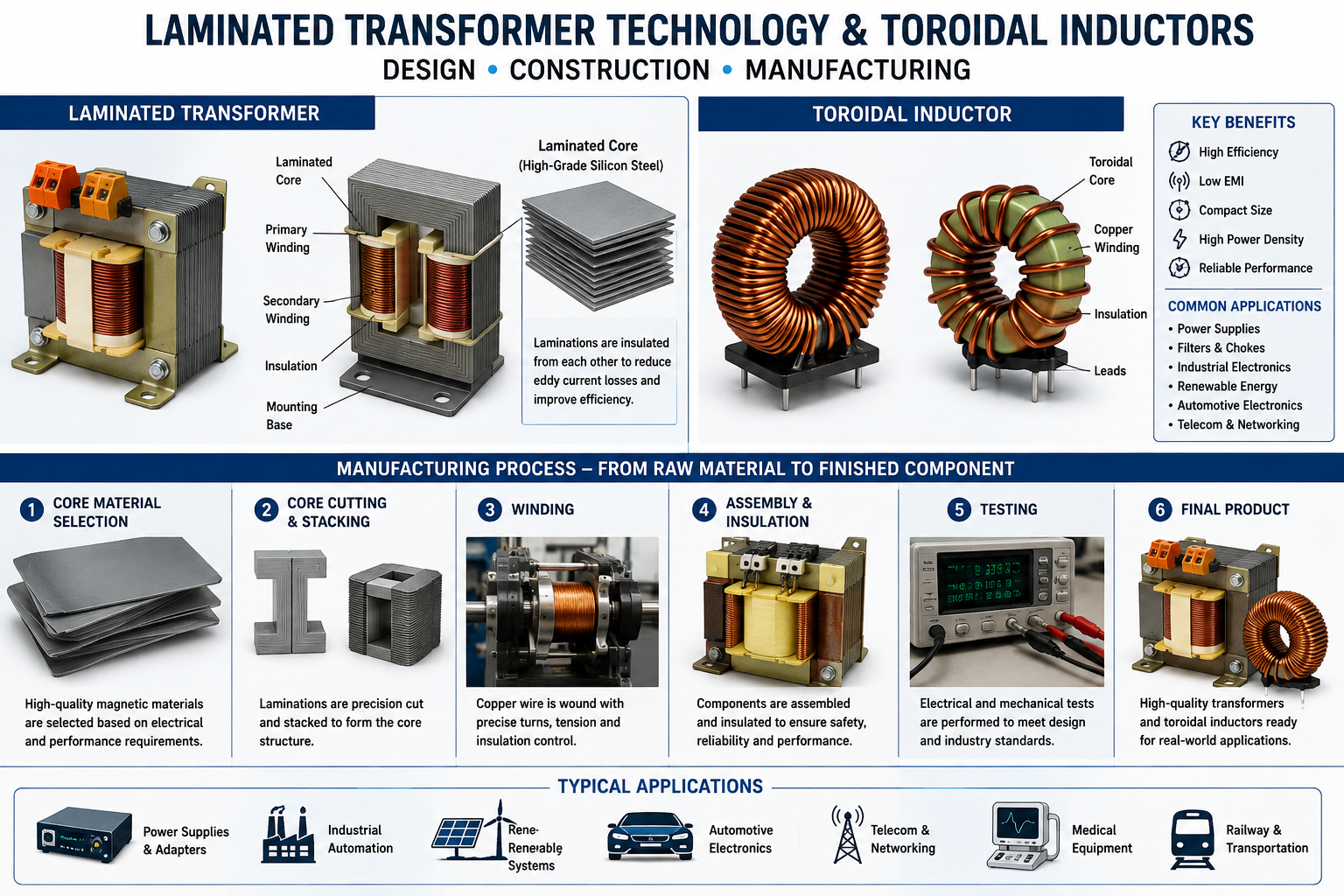
From compact power supplies to industrial control equipment, magnetic components play a quiet but important role in electrical systems. Their physical appearance can be simple—a winding around a core—but their design involves electrical, magnetic, thermal, and mechanical considerations.
Two examples are toroidal inductors and flyback transformers. Although both use magnetic principles, they perform different functions and are designed according to different operating requirements.
What Are Toroidal Inductors?
A toroidal inductor is an inductor wound around a ring-shaped magnetic core. The circular core provides a continuous magnetic path, while the winding carries the electrical current.
The term toroidal refers to the shape of the core rather than a specific electrical characteristic. Toroidal cores can be produced from different magnetic materials depending on the required frequency range, inductance, current level, and loss characteristics.
The construction of a toroidal inductor generally involves:
- A ring-shaped magnetic core
- Conductive winding wire
- Insulation between turns where required
- Protective or mechanical covering in certain designs
- Terminations for connection to the electrical circuit
The winding arrangement and number of turns determine much of the component’s electrical behavior.
Considerations in Toroidal Inductor Manufacturing
Toroidal inductors manufacturing in USA involves several stages, from material selection and winding to inspection and electrical testing. The exact manufacturing process varies according to component specifications and production volume.
Core selection is an early consideration. Different materials exhibit different permeability, saturation behavior, frequency characteristics, and losses. The conductor must also be selected according to expected current and thermal conditions.
Winding a conductor around a toroidal core requires careful control because the wire must pass through the center of the core repeatedly. The winding pattern can influence capacitance, resistance, magnetic performance, and the physical dimensions of the finished component.
Manufacturers may also need to consider:
- Inductance tolerance
- DC resistance
- Current rating
- Core losses
- Operating temperature
- Insulation requirements
- Winding consistency
- Mechanical dimensions
- Electrical testing requirements
For applications with specific space or electrical constraints, these details can become part of the overall component specification.
Why Core Material Matters
The magnetic core is one of the defining elements of an inductor. Materials respond differently to changing magnetic fields, particularly as frequency and current increase.
Ferrite, powdered iron, and other magnetic materials are used in different types of inductive components. Each material has characteristics that affect inductance, energy storage, losses, and saturation.
Selecting a core therefore involves more than choosing a particular physical shape. The material, dimensions, operating frequency, and expected magnetic flux all need to be considered together.
What Is a Flyback Transformer?
A flyback transformer is a magnetic component commonly associated with flyback converter circuits. Despite its name, it operates differently from a conventional transformer used primarily for direct energy transfer.
In a typical flyback circuit, energy is stored in the magnetic field during one part of the switching cycle. During another part of the cycle, that stored energy is transferred to the output through the secondary side.
This operating principle makes the magnetic design closely connected to the switching circuit. Parameters such as inductance, turns ratio, switching frequency, core material, air gap, winding arrangement, and insulation can all influence circuit behavior.
How a Flyback Transformer Works
A simplified flyback operation can be viewed as two main stages.
During the first stage, a switching device allows current to flow through the primary winding. Magnetic energy accumulates in the core and associated magnetic field.
When the switching device turns off, the magnetic field changes. This induces voltage in the windings, allowing energy to move toward the output side through the appropriate rectification and filtering circuitry.
The process occurs repeatedly at the converter’s switching frequency.
Because energy is intentionally stored in the magnetic component, the design must account for core saturation, stored energy, winding losses, insulation, and temperature rise.
Designing Around Operating Frequency
Frequency has a major influence on both inductors and flyback transformers.
At higher frequencies, magnetic cores can experience increased losses. Conductors can also exhibit effects such as skin effect and proximity effect, which influence effective resistance.
A flyback transformer operating at a particular switching frequency therefore cannot necessarily be evaluated using the same assumptions as a low-frequency transformer.
Designers typically examine:
- Switching frequency
- Maximum flux density
- Primary inductance
- Peak current
- Core losses
- Copper losses
- Duty cycle
- Temperature
- Leakage inductance
These parameters are interconnected, meaning that changing one part of the design can affect several others.
Manufacturing and Quality Considerations
Magnetic components require consistency because small variations in construction can affect electrical characteristics.
For example, differences in winding placement can change leakage inductance. Variations in the number of turns can affect inductance or turns ratio. Inconsistent insulation can influence dielectric performance.
Manufacturing processes may therefore include dimensional inspection, winding verification, inductance measurement, resistance testing, insulation testing, and other electrical checks.
The exact quality-control procedures depend on the component’s design and the requirements of the application.
Comparing the Two Components
Toroidal inductors and flyback transformers both use magnetic cores and conductive windings, but their purposes differ.
A toroidal inductor is generally associated with inductance and magnetic energy storage within a circuit. Its ring-shaped construction can be used in filtering, energy-storage, and other inductive circuit arrangements.
A flyback transformer is part of a switching power-conversion system where magnetic energy is stored and subsequently transferred between circuit sections.
Their design priorities therefore differ. An inductor may be specified primarily around inductance, current, resistance, and saturation characteristics, while a flyback transformer can additionally require careful consideration of turns ratio, primary inductance, leakage inductance, insulation, and switching behavior.
The Importance of Application-Specific Specifications
There is no single specification that defines every inductor or flyback transformer. Electrical and physical requirements depend heavily on the circuit in which the component will operate.
A useful specification should identify the relevant operating conditions before component construction begins. Depending on the application, this can include voltage ranges, current levels, frequency, temperature, dimensions, insulation requirements, and electrical tolerances.
Clear requirements also make testing more meaningful because measured performance can be compared with defined operating limits.
Conclusion
Toroidal inductors and flyback transformer demonstrate how magnetic components combine electrical engineering with material science and manufacturing techniques. Their performance depends on more than core shape or winding count; frequency, current, magnetic flux, thermal conditions, insulation, and construction quality all contribute to their behavior.
Understanding these fundamentals provides a clearer basis for evaluating magnetic components and their role in modern power-electronic systems, whether the focus is on toroidal inductors manufacturing in USA, flyback transformer design, or other specialized magnetic assemblies.